
INVESTOR RESOURCE CENTER
Learn the Process. Understand Your Options. Find the Right Resources.
Real estate investors have access to countless tools, services, funding options, and platforms—but knowing what you need, when you need it, and how it fits into your transaction can be just as important as finding the resource itself.
The Investor-Friendly Network Resource Center is designed to help investors and wholesalers better understand the tools and services that may support their businesses—from finding opportunities and managing leads to funding, closing, disposition, and beyond.
Education first. Resources second. Better-informed decisions at every stage of the deal.
01 — Find Investment Opportunities
Learn about property data, foreclosure research, lead generation, motivated-seller data, and tools investors use to identify potential opportunities.
02 — Manage Leads & Follow-Up
Learn how CRM systems, marketing tools, follow-up processes, and investor business systems can help organize leads and opportunities.
03 — Fund an Investment Property
Explore Financing Options for Your Deal
Learn about potential financing resources for fix-and-flip projects, rental, and hold strategies, new construction, refinancing, multifamily, commercial properties, and other qualifying real estate investment transactions.
04 — Complete a Double Closing
Learn what transactional funding is, how double closings generally work, and when this type of short-term funding may be considered.
05 — Get the Deal to Closing
Learn about investor-friendly title companies, attorneys, transaction coordination, and other resources that may help investors navigate the closing process.
06 — Sell or Disposition a Deal
Understand disposition, cash-buyer outreach, deal presentation, and resources that may help wholesalers and investors market contracted opportunities.
WHERE ARE YOU IN YOUR INVESTING JOURNEY?
Start With the Resource You Need
What Can Investors Research?
Property & Ownership Data
Research property characteristics, ownership information, sales history, and other available public or aggregated property data.
Distressed Property Opportunities
Explore information related to properties that may be experiencing foreclosure, pre-foreclosure, tax, lien, or other circumstances that could warrant additional research.
Equity & Mortgage Information
Estimated equity and mortgage-related data may help investors identify properties that potentially fit a particular acquisition strategy.
Market & Comparable Sales Data
Research nearby sales and market information that may help investors begin evaluating potential property values and opportunities.
Owner & Contact Information
Some data resources provide contact or skip-tracing information that investors may use for lawful property-owner outreach.
PROPERTY RESEARCH & LEAD GENERATION
Better Opportunities Start With Better Information
Finding potential investment opportunities often begins long before an offer is made. Investors use property data and lead-generation resources to research markets, identify properties that may fit their investment criteria, and better understand the circumstances surrounding a potential opportunity.
Targeted Lead Lists
Investors can create more focused prospecting lists based on criteria such as property characteristics, ownership status, equity indicators, location, or other available data points.
DATA IS A STARTING POINT—NOT DUE DILIGENCE
Verify Before You Act
Property-data platforms can be extremely useful, but information from databases, public records, automated estimates, and third-party sources may be incomplete, delayed, or inaccurate.
Before making an investment decision, investors should independently verify important information such as property ownership, title, liens, property condition, value, zoning where relevant, transaction requirements, and other facts that could affect the deal.
Good data can help you find an opportunity. Good due diligence helps you evaluate it.
Explore Property Research Resources
Looking for tools to help research properties, identify potential opportunities, build targeted lists, or better understand a market?
The Investor-Friendly Network provides access to resources that may help investors conduct property research and prospecting more efficiently.
CRM & LEAD MANAGEMENT
Finding the Lead Is Only the Beginning
Generating leads is an important part of real estate investing, but opportunities can easily fall through the cracks without an organized system for managing them.
A Customer Relationship Management system—or CRM—can help investors organize property leads, track conversations, schedule follow-ups, monitor deal progress, and maintain important information in one place.
For wholesalers and active investors, the goal isn't simply to collect more leads. It's to create a process for consistently managing the leads you already have.
What Can a Real Estate CRM Help You Manage?
01 — Lead Organization
Keep property information, seller details, notes, lead sources, and other important information organized instead of scattered across spreadsheets, notebooks, emails, and text messages.
02 — Seller Communication
Track conversations and important details so you have a clearer history of your communication with property owners and prospects.
03 — Follow-Up
Create reminders and follow-up processes for leads that aren't ready to move forward today but may become opportunities later.
04 — Deal Pipeline
Track potential opportunities through different stages—from a new lead and property evaluation to an offer, contract, disposition, and closing.
05 — Marketing & Lead Sources
Depending on the system being used, investors may be able to organize marketing campaigns and better understand where leads are coming from.
06 — Business Organization
Bring important parts of the acquisition process into a more organized workflow so investors can spend less time searching for information and more time evaluating opportunities.
FOLLOW-UP CAN BE PART OF THE STRATEGY
Not Every Seller Is Ready Today
A homeowner who isn't interested in selling today may have completely different circumstances several weeks or months from now.
That doesn't mean investors should pressure property owners. It means having an organized follow-up system can help investors maintain appropriate communication with prospects who have expressed interest or where continued contact is otherwise appropriate.
A strong lead-management process helps investors know:
Who needs follow-up → What was previously discussed → When to reconnect → Where the opportunity stands
A lead you forget about can't become a deal you close.
RESPONSIBLE OUTREACH MATTERS
Lead-generation and CRM tools do not replace an investor's responsibility to follow applicable laws and platform requirements.
Investors should understand the rules that may apply to telephone calls, text messages, email marketing, direct mail, consent, do-not-call requirements, and other forms of consumer outreach.
The availability of contact information does not automatically mean every method of contacting that person is permitted.
This is educational information and not legal advice. Investors should obtain appropriate professional guidance regarding the requirements that apply to their marketing activities.
Explore CRM & Lead Management Resources
Ready to create a more organized system for managing leads, follow-up, marketing, and potential deals?
The Investor-Friendly Network provides access to resources that may help real estate investors organize their lead-management process and build more consistent business systems.
INVESTOR FUNDING & FINANCING
The Right Funding Depends on the Deal
Finding an investment opportunity is only part of the equation. Investors also need to determine how a property will be acquired, renovated when necessary, held, refinanced, or ultimately sold.
Different investment strategies may require different types of financing. A fix-and-flip investor may have different funding needs than someone purchasing a long-term rental property.
Understanding the purpose of the financing is an important first step in identifying potential funding resources.
Understanding Common Investor Financing Options
01 — Fix-and-Flip Financing
Designed for investors purchasing properties they intend to renovate and resell.
Depending on the lender and transaction, financing may consider factors such as the purchase price, renovation budget, property value, borrower experience, and projected after-repair value.
Common Goal: Acquire → Renovate → Resell
02 — Rental Property Financing
Investors purchasing or refinancing properties they intend to hold as rentals may explore financing designed specifically for investment properties.
Depending on the financing program, qualification may consider property cash flow, rental income, borrower qualifications, property value, reserves, and other factors.
Common Goal: Acquire → Rent → Hold
03 — Private & Alternative Lending
Private and alternative financing can provide investors with options outside traditional owner-occupied mortgage lending.
These financing solutions may be used for certain acquisitions, renovations, bridge situations, or other qualifying investment-property transactions.
Terms, costs, collateral requirements, underwriting standards, and timelines can vary considerably by provider.
Common Goal: Access capital based on the transaction and investment strategy.
04 — Bridge & Short-Term Financing
Some investors need temporary financing to acquire or reposition a property before selling it, refinancing it, or moving into longer-term financing.
Short-term financing can offer flexibility in certain situations, but investors should carefully understand the costs, repayment timeline, and exit strategy.
Common Goal: Finance the gap between acquisition and the investor's longer-term plan.
DON'T COMPARE FUNDING ON INTEREST RATE ALONE
Understand the Full Cost and Terms
When evaluating potential financing, investors may want to consider:
Interest Rate — The rate charged on borrowed funds.
Points & Origination Fees — Upfront financing charges can affect the overall cost of capital.
Loan-to-Value / Loan-to-Cost — Understand how much of the purchase or project a lender may be willing to finance.
Renovation Funding — Determine whether rehabilitation costs may be included and how funds are distributed.
Term Length — Know when the financing matures.
Prepayment Terms — Determine whether paying the loan off early creates additional costs.
Closing Costs — Understand lender and transaction-related expenses.
Experience Requirements — Some programs may have requirements based on an investor's prior projects or other qualifications.
Exit Requirements — Make sure the expected sale or refinance timeline aligns with the financing.
Important notice
FUNDING IS NOT GUARANTEED
Financing availability and terms vary by lender, property, borrower, transaction, market, and program requirements.
The Investor-Friendly Network may provide educational information and access to third-party funding resources, but unless expressly stated otherwise, IFN is not the lender and does not make underwriting or credit decisions for independently operated financing providers.
Access to a funding resource does not guarantee approval, a particular rate, loan amount, term, or closing.
Explore Investor Funding Resources
Whether you're evaluating a fix-and-flip, rental acquisition, bridge financing, or another qualifying investment-property transaction, understanding your strategy can help you identify funding resources worth exploring.
BEFORE YOU APPLY
Know Your Deal—and Your Exit Strategy
Before exploring financing, an investor should be prepared to explain more than simply:
“I found a property and need money.”
Depending on the lender and financing program, investors may be asked about:
The Property
What are you purchasing, where is it located, and what is its current condition?
Purchase Price
How much are you paying for the property?
Rehabilitation Budget
If renovations are planned, approximately how much work will be required?
Property Value
What information supports the current or projected value?
Investment Strategy
Are you planning to flip, rent, refinance, or pursue another strategy?
Exit Strategy
How do you expect the financing to be repaid?
Funding should support the deal strategy—not become the deal strategy.
TRANSACTIONAL FUNDING
Understanding Funding for a Double Closing
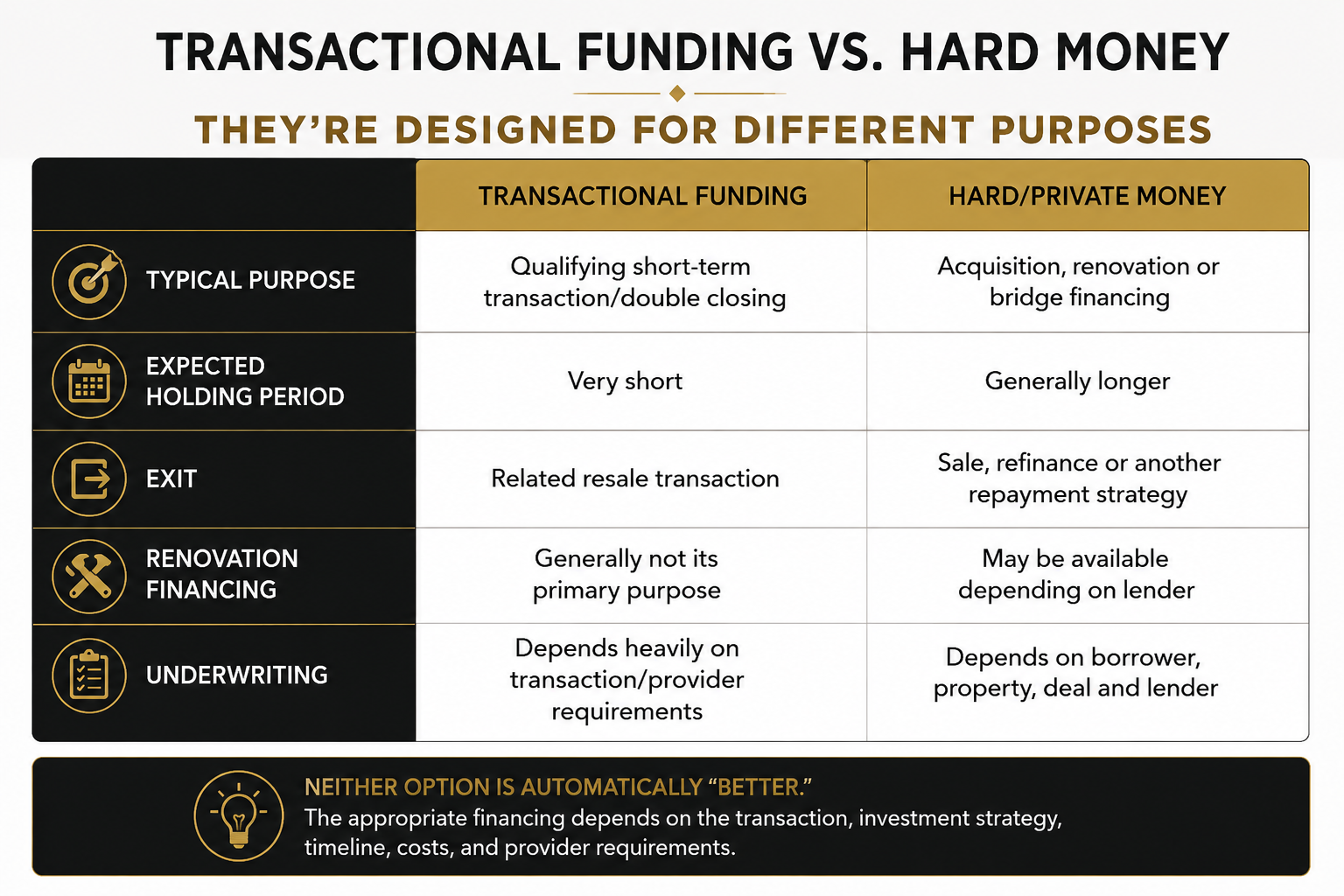
Transactional funding is a form of short-term funding that may be used in certain real estate transactions where an investor needs capital to complete one purchase before completing a related resale.
It is commonly associated with a double closing, where the investor actually purchases the property in one transaction and then sells the property in a separate transaction.
Unlike traditional investment-property financing, transactional funding is generally designed around a very short transaction timeline and a specific exit transaction.
The purpose isn't typically to finance a property for months or years. It's to provide capital for a qualifying transaction with a defined exit.
How Does a Double Closing Generally Work?
01 — Investor Contracts to Purchase
The investor enters into a purchase agreement with the property seller.
This first side of the transaction is commonly referred to as the A-to-B transaction, with the original seller as Party A and the investor as Party B.
02 — Investor Contracts With an End Buyer
The investor separately enters into an agreement to sell the property to an end buyer.
This is commonly referred to as the B-to-C transaction, with the investor as Party B and the end buyer as Party C.
03 — The A-to-B Transaction Closes
The investor must complete the purchase from the original seller according to the applicable contracts and closing requirements.
For a qualifying transaction, transactional funding may provide the capital necessary for the investor to complete this acquisition.
04 — The B-to-C Transaction Closes
The investor then completes the separate sale to the end buyer.
Funds from the second transaction may be used as part of settling the applicable obligations from the first transaction, subject to the closing structure and funding terms.
Assignment vs. Double Closing
TWO DIFFERENT TRANSACTION STRUCTURES
Assignment and Double Closing Are Not the Same Thing
Assignment
In an assignment transaction, an investor may transfer contractual rights under a purchase agreement to another buyer when the contract and applicable law permit it.
The investor generally does not purchase and resell the property through two separate closings.
Double Closing
In a double closing, the investor participates in two separate purchase-and-sale transactions:
Seller → Investor
followed by:
Investor → End Buyer
Because the investor is actually purchasing the property in the first transaction, funding may be required to complete that acquisition.
Transactional funding may help solve the capital requirement in a qualifying double closing—it does not replace the contracts, end buyer, title work, closing professionals, or other requirements of the transaction.
When Might an Investor Explore Transactional Funding?
A Double Closing Is Being Considered
The investor and appropriate professionals have determined that a double-closing structure may be appropriate for the transaction.
An End Buyer Has Been Identified
Transactional funders may have requirements regarding the investor's exit transaction and the end buyer's ability to complete the purchase.
Capital Is Needed for the Acquisition
The investor needs short-term capital to complete the first purchase before completing the subsequent resale.
The Transaction Meets Provider Requirements
Funding providers establish their own requirements regarding property type, documentation, closing professionals, timing, end-buyer funds, transaction structure, and other factors.
Explore Transactional Funding Resources
Planning a qualifying double closing and need to understand potential funding options?
The Investor-Friendly Network provides access to resources that may help investors explore transactional funding for eligible transactions.
What Should You Have Prepared?
BEFORE REQUESTING TRANSACTIONAL FUNDING
Depending on the provider and transaction, investors may be asked to provide information or documents such as:
A-to-B Purchase Contract
The agreement between the original seller and investor.
B-to-C Purchase Contract
The agreement between the investor and end buyer.
Property Information
Basic information regarding the property and transaction.
Closing / Title Information
Information regarding the title company, attorney, escrow provider, or other closing professional involved.
End-Buyer Information or Evidence of Funds
The provider may require documentation concerning the exit transaction or end buyer.
Closing Timeline
The expected timing of both transactions.
Requirements vary by provider and transaction. Investors should confirm the exact documentation and eligibility requirements before relying on transactional funding for a closing.
Important Notice
TRANSACTION STRUCTURE MATTERS
Double closings, assignments, wholesaling practices, disclosure requirements, licensing considerations, closing procedures, and applicable laws can vary by jurisdiction and circumstances.
The Investor-Friendly Network provides general educational information and access to resources. This information is not legal, tax, lending, or financial advice.
Investors should work with appropriately qualified closing and professional advisors and independently confirm that their transaction structure complies with applicable requirements.
The Right Closing Professional Can Matter to the Deal
Getting a property under contract is an important milestone—but the transaction still has to make it to the closing table.
Real estate investor transactions can involve assignments, double closings, entity purchases, funding requirements, title issues, liens, multiple contracts, and other circumstances that may differ from a traditional residential sale.
That's why investors should understand the importance of working with qualified closing professionals who are familiar with the type of transaction being completed.
A closing professional doesn't just process paperwork. The right professional can help identify issues that need to be addressed before the transaction reaches the closing table.
What Does “Investor-Friendly” Actually Mean?
01 — Familiarity With Investor Transactions
An investor-friendly closing professional may have experience with investment-property transactions and understand that investors can use different acquisition and disposition strategies.
02 — Understanding Assignments
Where legally permissible and appropriate for the transaction, the closing professional may be familiar with transactions involving the assignment of contractual rights.
03 — Experience With Double Closings
A closing professional familiar with double closings may better understand the coordination required when an investor is purchasing and separately reselling a property through two transactions.
04 — Familiarity With Investor Funding
Investor transactions may involve private lending, hard-money financing, transactional funding, or other funding arrangements that require coordination with the closing process.
05 — Title & Property Issues
Title searches may identify mortgages, liens, judgments, unpaid taxes, ownership issues, or other matters that may need to be addressed before clear or insurable title can be transferred.
06 — Communication & Coordination
Closing often involves communication among sellers, buyers, investors, lenders, attorneys, title professionals, transaction coordinators, and other parties.
Clear communication can help everyone understand outstanding requirements and upcoming deadlines.
BEFORE YOU SEND THE CONTRACT
Ask the Closing Professional the Right Questions
Instead of simply asking: “Are you investor-friendly?”
☐ Do you regularly work with real estate investors?
☐ Are you familiar with assignments when permitted and applicable?
☐ Do you handle double closings?
☐ Have you worked with transactional funding?
☐ Are there specific documentation requirements I should know about?
☐ Who will be my primary point of contact during the transaction?
☐ What fees should I expect for this type of closing?
☐ What information should I provide when submitting the contract?
☐ Are there transaction structures you do not handle?
☐ Are there state or local requirements I should discuss with an attorney?
“Investor-friendly” shouldn't just be a label. Ask questions to determine whether the professional is familiar with your particular type of transaction.
Title Company or Attorney?
CLOSING PRACTICES VARY BY LOCATION
Who Handles the Closing May Depend on the State
Real estate closing practices are not identical throughout the United States.
Depending on the state and transaction, title companies, attorneys, escrow companies, settlement agents, or other qualified professionals may perform different roles in the closing process.
That's one reason investors operating in multiple markets shouldn't assume that the closing process will work exactly the same everywhere.
Before entering a new market, understand who commonly handles real estate closings there and what requirements may apply to your transaction.
Featured Resource
The Investor-Friendly Network
Investor-Friendly Title Companies & Attorneys Directory
Find Closing Resources Across All 50 States
Finding a closing professional who understands real estate investor transactions can take time—especially when you're entering a new market.
The Investor-Friendly Network's Investor-Friendly Title Companies & Attorneys Directory was created to help investors begin their search for closing resources throughout the United States.
Use the directory as a starting point to identify potential title companies and attorneys and then contact the applicable professional directly to confirm services, experience, availability, fees, licensing where applicable, and whether they can accommodate your specific transaction.

Directory Notice: Inclusion in The Investor-Friendly Network directory does not constitute a guarantee, endorsement, or representation regarding a provider's licensing, availability, experience, pricing, services, or suitability for a particular transaction. Information may change over time. Investors are responsible for independently verifying providers and conducting appropriate due diligence before engaging any professional.
⭐ Covers All 50 States
⭐ Investor-Friendly Professionals
⭐ Real Estate Investor Resource
⭐ Digital Download
LEGAL QUESTIONS REQUIRE LEGAL GUIDANCE
The Investor-Friendly Network provides general educational information and resources and is not a law firm.
Real estate laws, wholesaling requirements, assignment rules, disclosure requirements, licensing requirements, contract requirements, and closing practices may vary by state and circumstances.
When a transaction raises a legal question, investors should seek guidance from an appropriately qualified attorney rather than relying solely on educational content, templates, online discussions, or another investor's experience.
DISPOSITION & TRANSACTION SUPPORT
Getting the Property Under Contract Is Only Part of the Deal
Once an investor has a property under contract, the focus shifts from finding the opportunity to determining how the transaction will move toward closing.
For wholesalers and investors who intend to sell or otherwise disposition an investment opportunity, this stage may involve preparing accurate deal information, communicating with potential buyers, coordinating with closing professionals, managing documents, and staying aware of important deadlines.
A strong opportunity can still run into problems when the process between contract and closing isn't properly managed.
What Is Disposition?
FROM CONTRACT TO POTENTIAL BUYER
Disposition Is More Than Posting a Property
In real estate investing, disposition generally refers to the process of marketing or otherwise moving an investment opportunity toward an appropriate buyer or exit.
For wholesalers, this may involve presenting a contracted opportunity to potential cash buyers or other investors, subject to the contract terms and applicable laws.
Effective disposition isn't simply about reaching as many people as possible.
It's about providing potential buyers with enough useful information to determine whether the opportunity may fit their investment criteria.
The goal isn't simply to find a buyer. It's to help qualified potential buyers evaluate the opportunity.
What Information May Buyers Want to See?
01 — Property Information
Basic property details such as location, property type, square footage, bedrooms and bathrooms, lot size, occupancy status, and other relevant characteristics.
02 — Property Condition
Available information about the property's current condition and known repairs or improvements that may be needed.
Avoid presenting estimated repair costs as guaranteed figures unless they have been properly evaluated.
03 — Purchase / Opportunity Price
Potential buyers need to understand the price or transaction terms being presented and any applicable requirements associated with the opportunity.
04 — Comparable & Value Information
Relevant comparable sales and other market information may help buyers conduct their own evaluation of potential property value.
05 — Photos & Supporting Information
Clear photographs, videos, inspection information where available, access instructions, and other relevant materials can help buyers evaluate the opportunity.
06 — Closing & Transaction Details
Potential buyers may need information regarding anticipated closing dates, earnest-money requirements, title or closing professionals, access, funding expectations, and other transaction-related requirements.
NOT EVERY RESPONSE IS A QUALIFIED BUYER
Know Who You're Working With
Generating interest in a property doesn't necessarily mean the transaction is ready to close.
Depending on the transaction, investors may want to understand whether a potential buyer:
Has reviewed the opportunity
The buyer should have enough information to make an informed decision.Understands the transaction requirements
Important deadlines, deposits, closing expectations, and other applicable terms should be understood.Has the ability to perform
Depending on the transaction, appropriate evidence of available funds or financing may be requested.Can meet the anticipated timeline
The buyer's ability to close should align with the applicable transaction deadlines.Buyer interest and buyer ability are not the same thing
AFTER THE BUYER IS IDENTIFIED
The Deal Still Has to Reach the Closing Table
Once the transaction begins moving toward closing, there may be numerous documents, communications, deadlines, and parties involved.
Transaction coordination can help keep the administrative side of the transaction organized.
Depending on the service and transaction, support may include:
Contract & Document Organization
Keeping important transaction documents organized and accessible.
Deadline Tracking
Monitoring important contractual and closing-related dates.
Communication Coordination
Helping maintain communication among appropriate parties involved in the transaction.
Closing Follow-Up
Tracking outstanding administrative items as the transaction progresses.
Status Updates
Helping the investor understand where the transaction stands and what may still be needed.
DIFFERENT PROFESSIONALS. DIFFERENT RESPONSIBILITIES.
A transaction may involve several professionals performing different roles.
Transaction Coordinator
May assist with administrative organization, communication, documentation, and deadline tracking within the scope of the service provided.
Title / Settlement Professional
May handle title-related and settlement functions depending on the jurisdiction and transaction.
Attorney
Provides legal advice and legal services within the attorney's authorized scope.
Lender / Funding Provider
Determines financing eligibility and requirements for applicable financing.
Investor
Remains responsible for understanding the transaction, performing appropriate due diligence, complying with contractual obligations, and making business decisions.
Transaction support can help organize the process, but it doesn't replace legal advice, due diligence, funding approval, or the responsibilities of the parties to the transaction.
Explore Disposition & Transaction Resources
Need Help Moving a Deal Toward Closing?
Whether you're looking for disposition support, buyer outreach resources, or assistance managing the administrative process between contract and closing, The Investor-Friendly Network provides access to resources designed to support investors through the next stage of the transaction.
Transaction Notice: Services, requirements, transaction structures, marketing practices, assignment rules, licensing requirements, disclosures, and other legal requirements may vary by state and circumstances. The Investor-Friendly Network provides general educational information and access to resources and does not provide legal advice. Investors are responsible for conducting appropriate due diligence and complying with applicable contracts, laws, and professional requirements.
REAL ESTATE DOCUMENTS & BUSINESS RESOURCES
The Right Document Matters—But So Does Understanding What You're Signing
Real estate investing involves more than properties and funding. Investors may also encounter contracts, notices, agreements, business documents, and other paperwork throughout the life of a transaction or business.
Document resources and templates can provide a useful starting point, but investors should understand the purpose of a document, the obligations it creates, and whether it is appropriate for the particular transaction and jurisdiction.
A template can help you create a document. It cannot decide whether that document is legally appropriate for your situation.
Documents Investors May Encounter
01 — Purchase & Sale Documents
Real estate transactions may involve purchase agreements, addenda, amendments, disclosures, and other documents establishing or modifying transaction terms.
Requirements can vary depending on the property, parties, transaction, and jurisdiction.
02 — Assignment-Related Documents
Certain transactions may involve the assignment of contractual rights when permitted by the underlying agreement and applicable law.
Investors should understand the contract terms and applicable requirements before attempting to assign contractual rights.
03 — Property & Rental Documents
Investors who own or manage rental properties may encounter leases, notices, property-management documents, and other landlord-related paperwork.
Landlord-tenant requirements vary considerably by jurisdiction.
04 — Business Documents
Real estate investors operating businesses may use documents involving independent contractors, confidentiality, business relationships, services, or other operational matters.
05 — Lending & Payment Documents
Certain private transactions may involve promissory notes, repayment agreements, or other financing-related documents.
These arrangements can create significant legal and financial obligations and may warrant professional guidance.
06 — Notices & Other Agreements
Depending on the situation, investors may encounter notices, releases, authorizations, affidavits, or other transaction and business documents.
The appropriate document depends on the circumstances.
Templates vs. Legal Advice
KNOW THE DIFFERENCE
A Document Template Is a Tool—not Legal Advice
Online document resources can make it easier to create commonly used documents, but a template generally relies on the information and selections provided by the person completing it.
A template may not identify every legal issue, unusual circumstance, state-specific requirement, or risk involved in a particular transaction.
Before relying on an important document, investors should consider:
What does this document actually do?
What obligations am I accepting?
Does it apply in the state where the transaction or property is located?
Does my existing contract permit what I'm trying to accomplish?
Are required disclosures or additional documents involved?
Could this document create financial or legal consequences I don't fully understand?
Don't use a document simply because another investor uses it. Understand what it does and whether it fits your transaction.
State Requirements Matter
REAL ESTATE ISN'T ONE-SIZE-FITS-ALL
A Document Used in One State May Not Be Appropriate in Another
Real estate laws, contract requirements, disclosures, wholesaling rules, landlord-tenant requirements, closing practices, and other legal requirements can vary by state and sometimes by local jurisdiction.
That becomes especially important for investors operating in multiple markets.
Before using a document in a new market, determine whether state or local requirements affect how that document should be prepared or used.
When appropriate, consult an attorney licensed in the relevant jurisdiction.
Business Organization Matters Too
BUILD THE BUSINESS BEHIND THE DEALS
Stronger Systems Can Support a Stronger Investing Business
As an investing business grows, organization becomes increasingly important.
Depending on the business and circumstances, investors may need systems for managing:
Business Records
Contracts, closing documents, receipts, invoices, and other records.Vendor & Contractor Information
Information relating to contractors and other service providers.Transaction Files
Organized records for individual properties and deals.Business Agreements
Documents governing certain business relationships and services.Compliance Records
Records relating to applicable business, marketing, licensing, tax, or other requirements.Financial Records
Documentation supporting income, expenses, financing, and business transactions.Explore Document & Business Resources
Need a Starting Point for a Document?
The Investor-Friendly Network provides access to resources that may help investors create, organize, and better understand commonly used real estate and business documents.
Important Legal Notice
Legal Notice: The Investor-Friendly Network is not a law firm and does not provide legal advice or create an attorney-client relationship through its educational content or resource links. Document templates and third-party document services may not be appropriate for every transaction or jurisdiction. Users are responsible for reviewing documents, verifying applicable requirements, and obtaining advice from an appropriately qualified attorney when necessary.
THE INVESTOR DEAL JOURNEY
From Opportunity to Closing—and Beyond
Real estate investing isn't one single step. A potential opportunity may move through research, follow-up, analysis, funding, contracts, disposition, and closing before the transaction is complete.
Understanding how those pieces connect can help investors identify what they need now—and what they may need next.
01 — FIND
Identify the Opportunity
Research properties, markets, distressed-property information, ownership data, and potential leads.
Resource: Property Data & Lead Generation
↓
02 — MANAGE
Organize the Lead
Track property information, seller conversations, follow-up, marketing activity, and potential opportunities.
Resource: CRM & Lead Management
↓
03 — ANALYZE
Evaluate the Deal
Review available property information, comparable sales, estimated repairs, potential costs, transaction structure, and your investment strategy.
Remember: Data and estimates are starting points. Appropriate due diligence still matters.
↓
04 — FUND
Determine the Capital Strategy
Consider how the acquisition or transaction may be funded based on the property, strategy, timeline, and exit plan.
Resource: Investor Financing / Transactional Funding
↓
05 — CONTRACT
Understand the Transaction
Review the applicable agreements, obligations, deadlines, closing requirements, and documents involved.
Resource: Closing, Legal & Document Resources
↓
06 — DISPOSITION
Prepare the Exit
When applicable to the investor's strategy and transaction, prepare accurate property information and explore appropriate buyer or disposition resources.
Resource: Disposition Support
↓
07 — CLOSE
Move the Transaction to the Finish Line
Coordinate applicable documents, funding, title or settlement requirements, communications, deadlines, and other closing-related items.
Resource: Closing & Transaction Support
↓
08 — GROW
Build a Repeatable Business
Learn from completed transactions, improve systems, organize records, strengthen follow-up, continue your education, and refine your investment process.
Resource: IFN Education & Business Resources
THE RESOURCE YOU NEED CHANGES WITH THE DEAL
You Don't Need Every Tool at Once
A new investor searching for their first opportunity has different needs than an investor preparing for a double closing.
The goal isn't to sign up for every platform, service, or funding product available.
The goal is to understand where you are in the transaction, identify the problem that needs to be solved, and then evaluate the resources that may help solve it.
Start with the problem. Understand the process. Then choose the resource.
EDUCATION DOESN'T END WITH THE TOOL
Build Your Knowledge Along With Your Business
Tools and services can support a real estate investing business, but they don't replace understanding the fundamentals.
The Investor-Friendly Network's educational content is designed to help investors and wholesalers better understand the concepts behind the resources—from property research and funding to closing, disposition, and business systems.
BUILD WITH KNOWLEDGE. MOVE WITH CONFIDENCE.
Your Next Deal Starts With Understanding Your Next Step.
Whether you're looking for opportunities, organizing leads, evaluating funding, preparing for closing, or building better systems, The Investor-Friendly Network is here to help you understand the process and explore resources for the journey ahead.
Education. Resources. Connections. Built for Real Estate Investors.