
Assignment vs. Double Closing: What's the Difference?
Real estate wholesalers may encounter two different ways of completing a transaction: assigning a purchase contract or completing a double closing. Learn how each approach works, the key differences, potential costs, funding considerations, and questions investors should ask before choosing a transaction structure.
You Have a Property Under Contract and an End Buyer. What Happens Next?
Finding a potential deal is only part of the wholesaling process.
Once an investor has entered into a purchase agreement and identified an end buyer, another important decision may arise:
Should the contract be assigned, or should the transaction be completed through a double closing?
At first glance, the two strategies may seem similar.
Both can involve:
An original seller.
An investor or wholesaler.
An end buyer.
But what happens between those parties can be very different.
With an assignment, the investor generally transfers their contractual rights or interest to another buyer when the contract and applicable law allow it.
With a double closing, the investor actually participates in two separate real estate transactions—first purchasing the property and then reselling it to the end buyer.
Understanding that distinction is essential before comparing costs, funding, paperwork, risks, and potential benefits.
What Is a Real Estate Contract Assignment?
An assignment occurs when a party to a purchase contract transfers its contractual interest or rights to another party, assuming the contract permits assignment and applicable requirements are satisfied.
In a typical wholesale scenario:
SELLER (A)
↓
Purchase Contract
↓
INVESTOR / WHOLESALER (B)
↓
Assignment of Contractual Interest
↓
END BUYER (C)
The investor generally does not purchase the property first.
Instead, the end buyer steps into the transaction through the assignment and ultimately purchases the property from the seller.
The wholesaler may receive an assignment fee as part of the transaction.
This is fundamentally different from selling property the investor already owns. The interest being transferred is contractual, and disclosure and other legal requirements can vary by jurisdiction. Texas, for example, specifically requires someone assigning an interest in a purchase contract without a real estate license to disclose in writing the nature of that equitable interest.
A Simple Assignment Example
Suppose an investor enters into a purchase contract with a seller for:
$100,000
The investor then finds an end buyer willing to take over the investor's contractual position for an agreed assignment fee of:
$10,000
If properly structured and permitted, the investor assigns the contractual interest to the end buyer.
The end buyer then proceeds toward purchasing the property from the original seller.
So instead of:
Seller → Investor → End Buyer
the property itself ultimately transfers:
Seller → End Buyer
while the investor's contractual interest is what was assigned.
That's the first major concept to understand:
In an assignment, the wholesaler generally transfers a contractual interest rather than purchasing and reselling the property.
What Is a Double Closing?
A double closing is different because there are two separate purchase-and-sale transactions.
Transaction #1: A-B
Original Seller (A) → Investor (B)
The investor purchases the property from the original seller.
Transaction #2: B-C
Investor (B) → End Buyer (C)
The investor then sells the property to the end buyer.
Visually:
SELLER (A)
↓
A-B CLOSING
↓INVESTOR (B)
↓
B-C CLOSING
↓END BUYER (C)
Unlike an assignment, the investor becomes a buyer in the first transaction and a seller in the second.
That's why a double closing can create additional considerations involving funding, closing costs, settlement procedures, documentation and timing.
Industry explanations likewise distinguish a double closing as two back-to-back transactions from an assignment of the wholesale contract.
Assignment vs. Double Closing at a Glance
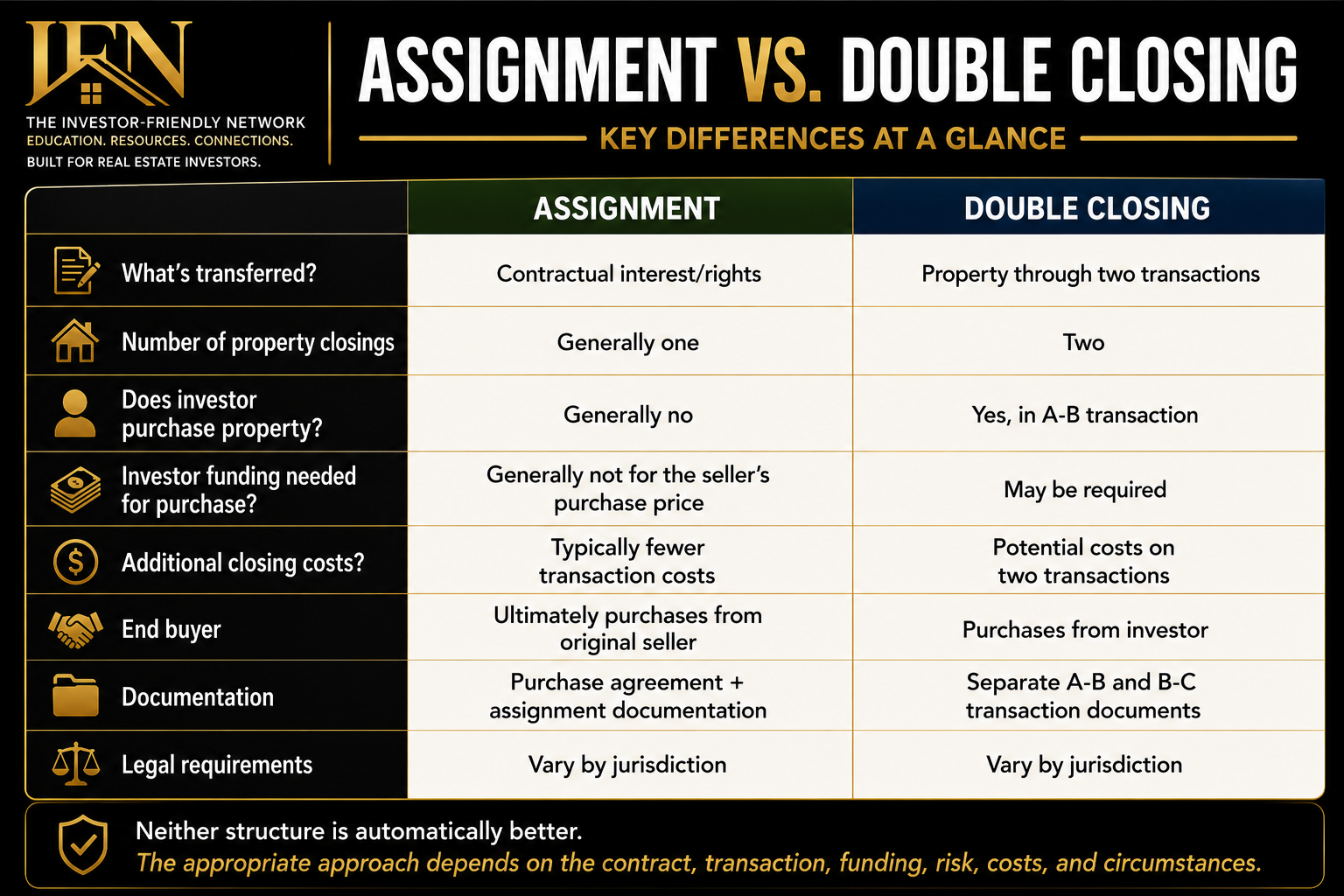
Neither structure is automatically better. The appropriate approach depends on the contract, transaction, funding, closing professionals, applicable law, costs and circumstances.
Why Might an Investor Consider an Assignment?
An assignment can sometimes provide a relatively straightforward way to transfer a contractual position to an end buyer.
An investor might explore an assignment when:
The Purchase Contract Allows Assignment
Not every contract is assignable.
Investors should understand the language in their actual agreement rather than assuming assignment is permitted.
Applicable Requirements Can Be Satisfied
Wholesaling laws and disclosure requirements vary.
For example, Texas permits selling or assigning certain equitable interests without a real estate license when specified requirements are met, including written disclosure of the nature of the interest.
The End Buyer Is Comfortable With the Structure
The parties and closing professional need to understand what is actually being transferred.
The Investor Doesn't Need to Purchase the Property
Because the investor generally isn't completing an A-B property purchase, acquisition financing may not be required in the same way it can be for a double closing.
Why Might an Investor Consider a Double Closing?
A double closing may be explored when the investor intends to actually purchase the property before reselling it.
Some circumstances investors may evaluate include:
The Transaction Isn't Being Completed as an Assignment
The investor is purchasing the property rather than transferring only the contractual interest.
The Investor Wants Separate Transactions
The seller-to-investor purchase and investor-to-end-buyer resale are separate closings.
The Contract or Transaction Structure Calls for a Purchase and Resale
An investor may determine, with the appropriate professionals, that completing two transactions better fits the circumstances.
The Investor Can Satisfy the Funding Requirements
Because the investor is actually purchasing the property during the A-B closing, sufficient capital must be available.
Where Does Transactional Funding Come In?
A double closing creates an important question:
How does the investor fund the A-B purchase?
Some investors use their own capital.
Others may explore financing.
For qualifying transactions, transactional funding may provide short-term capital to complete the A-B purchase before the subsequent B-C transaction.
But transactional funding has its own requirements, costs, timelines and risks.
Want to understand how it works?
Let's Compare the Numbers
Suppose:
A-B Purchase Price: $100,000
B-C Resale Price: $115,000
The difference is:
$15,000
But here's where beginners sometimes make a mistake.
That $15,000 is not automatically net profit.
In a double closing, expenses may include:
Funding costs
Settlement/title charges
Closing costs associated with the A-B transaction
Closing costs associated with the B-C transaction
Recording or transfer-related charges where applicable
Other transaction-specific expenses
With an assignment, the economics are structured differently because the investor is generally transferring a contractual interest rather than completing two property purchases.
Therefore, investors shouldn't choose between an assignment and double closing based solely on:
“Which one pays me more?”
A better question is:
Which transaction structure appropriately fits the deal after considering the contract, costs, funding, risk, legal requirements and closing process?
Don't Choose a Double Closing Just to Hide the Spread
You may hear investors say:
“Just double close so nobody sees how much you're making.”
That explanation is incomplete.
A double closing is a transaction structure, not simply a technique for concealing profit.
It involves two actual transactions and can bring additional funding requirements, closing costs, documents, timing considerations and legal obligations.
An investor should understand why the transaction is being structured that way, not simply choose it because someone on social media said the assignment fee was “too big.”
Questions to Ask Before Choosing Either Structure
Before deciding how a transaction should proceed, investors should consider questions such as:
Does my purchase contract permit assignment?
What exactly am I transferring or selling?
What disclosures are required?
Are there wholesaling laws or licensing requirements in this jurisdiction?
Does the seller understand my role in the transaction?
Does the end buyer understand the transaction?
Can my title company, closing attorney or settlement professional handle the proposed structure?
What will each option cost?
If double closing, how will the A-B purchase be funded?
What happens if the end buyer doesn't close?
Are there restrictions in the financing being used by any party?
Should an attorney review the transaction or documents?
The Biggest Difference
Assignment
The investor generally transfers a contractual interest to the end buyer.
Double Closing
The investor actually purchases the property and then resells it through a second transaction.
That difference affects almost everything else:
Funding.
Documents.
Costs.
Closing procedures.
Risk.
Disclosure.
Legal considerations.
Once an investor understands that distinction, the rest of the transaction becomes much easier to understand.
Frequently Asked Questions
Is assigning a contract the same as selling the property?
No. Generally, an assignment involves transferring contractual rights or an equitable interest rather than selling property the assignor owns. How that interest must be described or disclosed depends on applicable law and the transaction.
Does an investor own the property during a double closing?
The investor is the purchaser in the A-B transaction and seller in the B-C transaction. The exact mechanics of title transfer, recording and settlement should be confirmed with the closing professionals handling the transactions.
Do you need transactional funding for every double closing?
No. An investor may have another permissible source of funds. Transactional funding is one potential funding method for qualifying transactions.
Is an assignment cheaper than a double closing?
It may involve fewer transaction expenses because there aren't two separate property purchases, but actual costs depend on the transaction, contracts, jurisdiction and closing arrangements.
Is wholesaling legal?
This question can't responsibly be answered with a universal yes or no without considering the activity and jurisdiction. Laws governing assignments, marketing, disclosures, licensing and wholesaling differ by state and can change. Investors should verify current requirements where the property is located. Texas, for example, permits certain assignments of equitable interests without a real estate license when its disclosure and other requirements are satisfied.
Can every purchase contract be assigned?
No. Investors need to review the actual contract and applicable requirements. Some contracts may restrict or prohibit assignment.
The IFN Approach
Understand the Structure Before You Choose the Strategy
Real estate investing isn't just about finding a property and finding a buyer.
Understanding how the transaction gets from contract to closing matters too.
An assignment and a double closing can produce very different obligations, costs and risks.
That's why investors should understand the transaction first, involve the appropriate closing and legal professionals when needed, and then determine which available approach fits their particular circumstances.
Learn the process. Ask better questions. Make more informed decisions.
Continue Learning
NEW TO TRANSACTIONAL FUNDING?
If you're considering a double closing and want to understand how short-term transactional funding may work, continue with our beginner's guide.
Educational Disclaimer: This article is provided for general educational and informational purposes only and does not constitute legal, financial, tax, real estate brokerage, lending, or investment advice. Contract rights, assignment requirements, wholesaling laws, disclosure obligations, licensing rules, closing practices and other requirements vary by jurisdiction and transaction. Investors should review their contracts, conduct independent due diligence, and consult appropriately qualified legal, title, tax, financial, lending, or other professionals regarding their specific circumstances.
