
What Is Transactional Funding? A Beginner's Guide for Real Estate Investors
Transactional funding can help real estate investors complete certain short-term transactions, particularly double closings. Learn how it works, what A-B and B-C transactions mean, what investors should consider, and how transactional funding differs from traditional investment financing.
You Found the Deal. You Found the Buyer. But There's One Problem—You Need the Money to Close.
Imagine this:
You have a property under contract for $100,000.
You've identified an end buyer who has agreed to purchase the property from you for $115,000.
Instead of assigning your original contract, the transaction will be completed using a double closing.
That means you aren't simply transferring your contractual interest to another buyer.
You actually need to purchase the property first.
And that creates an important question:
Where does the money for the first closing come from?
That's one situation where transactional funding may come into the picture.
Transactional funding is a specialized form of short-term financing commonly associated with real estate double closings. It can provide the capital an investor needs to complete the first purchase before the property is subsequently sold to the end buyer.
But transactional funding isn't simply “easy money,” and it isn't appropriate for every transaction.
To understand when it may make sense, you first need to understand how the transaction itself works.
What Is Transactional Funding?
Transactional funding is generally a very short-term source of capital used to complete a real estate purchase when the investor has a planned subsequent transaction that will provide the exit from the funding.
One common application is a real estate wholesale double closing.
Unlike financing intended to hold a property for months or years, transactional funding is generally structured around a much shorter transaction timeline.
The exact requirements, fees, underwriting and permitted timelines depend on the funding provider.
For example, one current transactional-funding provider requires the A-B and B-C transactions to fund on the same day and through the same title company for its standard program. That is a provider-specific requirement, however—not something we should present as a universal rule for every transactional lender.
Key takeaway
Transactional funding is designed to help fund a transaction—not typically to finance long-term ownership of the property.
First, Understand the Double Closing
A double closing involves two separate real estate transactions.
Transaction 1 — A to B
A = Original Seller
B = Investor
The investor purchases the property from the original seller.
Ownership transfers according to the applicable closing process.
Transaction 2 — B to C
B = Investor
C = End Buyer
The investor then sells the property to the end buyer through a second transaction.
So visually:
SELLER (A)
↓
A-B PURCHASE
↓
INVESTOR (B)
↓
B-C RESALE
↓
END BUYER (C)
That's why you'll frequently hear double closings described as:
A-B / B-C transactions.
Transactional funding may provide the capital required for the A-B purchase, with repayment tied to the subsequent transaction according to the lender's terms and closing structure.
Let's Put Numbers to It
This is where we make the article useful to a beginner.
Example Transaction
Suppose:
Seller agrees to sell property to investor: $100,000
Investor agrees to sell property to end buyer: $115,000
There are now two transactions.
A-B Closing
Seller → Investor
Purchase price: $100,000
The investor must have sufficient funds available to complete this purchase.
If the transaction qualifies, transactional funding may provide some or all of the required acquisition capital, subject to the provider's requirements.
B-C Closing
Investor → End Buyer
Resale price: $115,000
The second transaction closes according to its terms.
Funds from the B-C transaction may then be used as part of settling the transactional funding and other applicable closing obligations.
Does the Investor Make $15,000?
Not necessarily.
And this is an important teaching moment.
The difference between $115,000 and $100,000 is a $15,000 gross spread.
But that isn't automatically $15,000 of profit.
There may be:
Transactional funding fees
Title/settlement charges
Closing costs on the A-B transaction
Closing costs on the B-C transaction
Taxes or recording-related charges where applicable
Other transaction-specific expenses
So:
Gross spread is not the same thing as net profit.
That is exactly why investors should understand the full transaction before agreeing to the numbers.
Transactional Funding vs. Assignment
This is another important distinction.
With an assignment, the investor generally transfers contractual rights to another party when the contract and applicable law permit it.
The investor typically does not purchase and take ownership of the property as part of two separate purchases.
With a double closing, there are two separate transactions, and the investor is actually a purchaser in the A-B transaction before becoming the seller in the B-C transaction.
Assignment
Seller → End Buyer
Investor transfers applicable contractual interest.
Double Closing
Seller → Investor → End Buyer
Investor participates in two separate transactions.
That distinction is why funding can become necessary.
An assignment and a double closing are not interchangeable terms.
When Might an Investor Explore Transactional Funding?
Transactional funding may be worth exploring when:
A Double Closing Is Being Considered
The investor expects to purchase the property and subsequently resell it rather than complete an assignment.
An End Buyer Has Been Identified
Because transactional funding is generally short-term and transaction-driven, providers may require evidence of the subsequent B-C transaction.
Capital Is Needed for the First Purchase
The investor needs funding to complete the A-B acquisition.
The Transaction Fits the Provider's Requirements
Every provider can establish its own underwriting standards, documentation requirements, timelines, fees and closing procedures.
This last point is critical.
Never assume that because one transactional funding company will fund a particular structure, another company will do the same.
What Might a Transactional Funding Provider Request?
Requirements vary, but an investor should be prepared to provide information such as:
Executed A-B purchase contract
Executed B-C resale contract
Property information
A-B purchase price
B-C resale price
Anticipated closing date
Investor/entity information
Title company, closing attorney or settlement information
Information concerning the end buyer
Other documentation required by the provider
For example, one provider's current application requests both contracts, property and entity information, the A-B and B-C prices, closing date and title/escrow contact information.
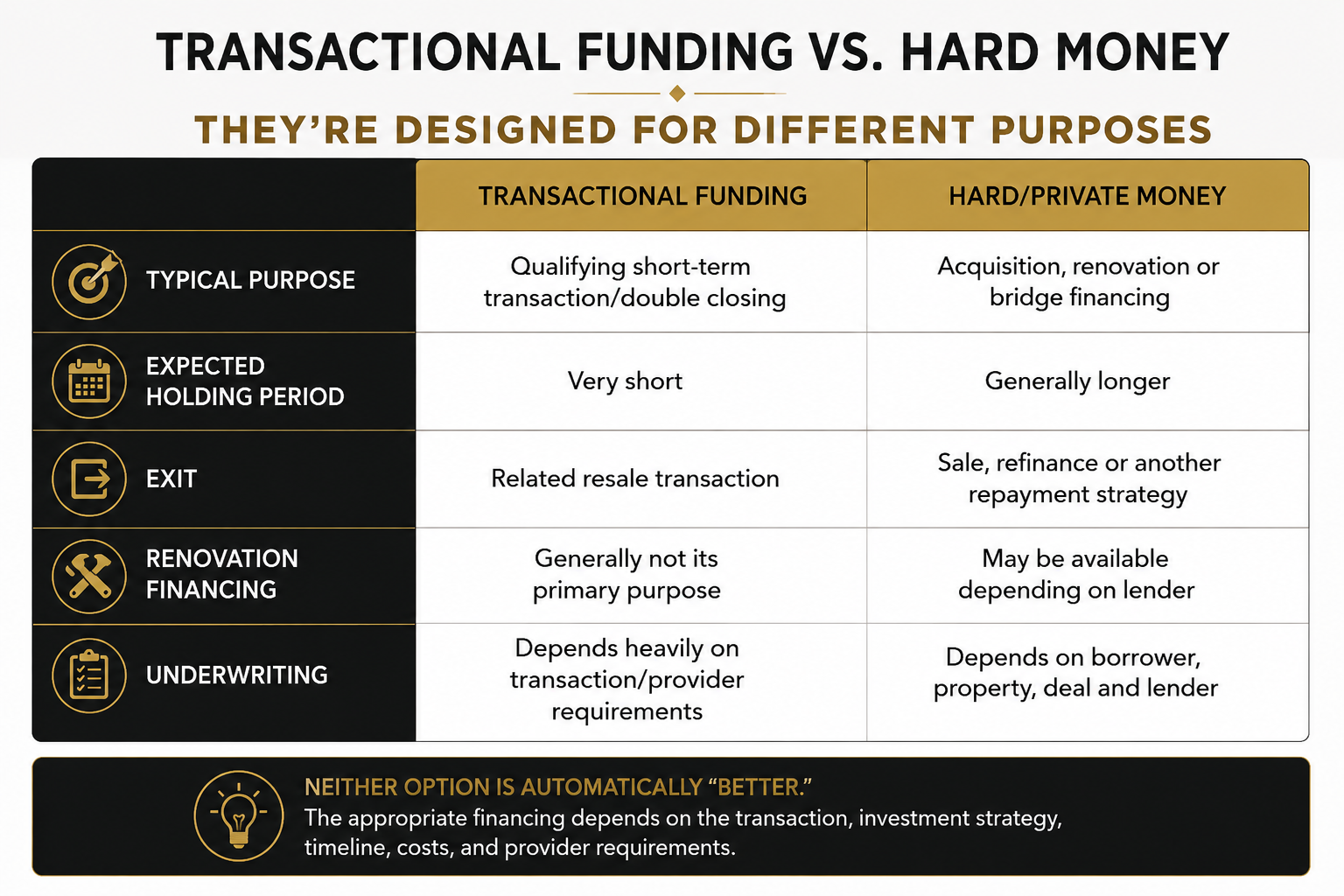
Transactional Funding vs. Hard Money
They're Designed for Different Purposes
Transactional funding and hard/private-money financing may both provide capital to real estate investors, but they're generally designed to solve different problems.
Transactional funding is commonly associated with very short-term transactions such as qualifying double closings.
Hard or private-money financing may instead be structured for property acquisition, renovation, bridge financing or a longer holding period.
Neither is automatically better. The appropriate financing depends on the transaction, strategy, timeline, costs, exit plan and lender requirements.
Questions to Ask Before Choosing a Transactional Funding Provider
Before selecting a provider, consider asking:
What transactions do you fund?
What are your eligibility requirements?
Do the A-B and B-C closings have to occur on the same day?
Do both transactions have to use the same title company or closing attorney?
What documents are required?
How much of the A-B transaction can you fund?
What are all of the fees?
Are there minimum or maximum transaction amounts?
What happens if the B-C transaction doesn't close as expected?
How early should I submit my transaction for review?
Are there states or transaction types you don't fund?
Does my title company or closing attorney need to approve or coordinate with your process?
That turns someone from simply asking:
“How much does transactional funding cost?”
into someone who understands that structure and requirements matter too.
What Can Go Wrong?
Transactional funding doesn't eliminate transaction risk.
Potential issues can include:
The End Buyer Doesn't Perform
If the expected B-C transaction fails, that can create serious complications depending on how the A-B purchase and funding were structured.
Closing Timing Changes
Title issues, documents, funding delays or other problems can disrupt a tightly coordinated closing schedule.
The Title or Closing Professional Can't Accommodate the Structure
Investors should communicate with the appropriate closing professional early rather than assuming every office handles double closings the same way.
The Numbers Don't Work After Costs
A deal that appears profitable based solely on the purchase and resale prices may look very different after financing and closing costs are calculated.
Legal or Regulatory Requirements Are Overlooked
Real estate laws, wholesaling rules, disclosures, licensing requirements and closing practices can vary by jurisdiction and circumstances.
Funding can solve a capital problem. It cannot fix a poorly structured transaction.
The Bigger Lesson
Understand the Transaction Before You Choose the Funding
Transactional funding can be a useful tool for certain real estate transactions.
But the question shouldn't simply be:
“Can I get transactional funding?”
A better set of questions is:
What transaction am I actually completing?
Why do I need the funding?
What will repay it?
What happens if the expected exit doesn't occur?
What are the total costs?
Does the closing professional understand the transaction?
Does the transaction comply with applicable requirements?
That's the IFN philosophy in action:
Understand the problem. Learn the process. Then evaluate the resource.
Frequently Asked Questions
Is transactional funding the same as hard money?
No. Although both may provide capital for real estate transactions, transactional funding is generally designed for very short-term transactions with a defined exit, while hard/private-money loans may finance acquisitions, renovations or longer holding periods.
Do I need an end buyer before applying?
Many transactional-funding structures depend heavily on the planned B-C transaction, but requirements vary by provider. Investors should confirm exactly what documentation and end-buyer commitments a particular provider requires.
Does transactional funding require a credit check?
Not necessarily. Some transactional funding providers advertise programs that do not rely on personal credit, but that should not be presented as universal. Qualification standards vary by provider. For example, DoubleClose currently states that its standard transactional-funding program does not use personal credit as a qualification factor.
Can transactional funding cover 100% of the purchase?
Some providers offer up to 100% funding for qualifying transactions, while others may structure funding differently. Always verify exactly what the provider will and will not fund.
Are transactional funding fees the same everywhere?
No. Fees and costs are provider-specific and can vary with the transaction amount, structure and other factors.
Is a double closing legal everywhere?
Closing practices, wholesaling regulations, disclosure requirements, licensing rules and other requirements can vary by state and circumstances. Investors should not rely on a general internet article to determine whether a specific transaction is legally compliant. Consult appropriately qualified professionals in the relevant jurisdiction.
Ready to Learn More?
EXPLORE TRANSACTIONAL FUNDING RESOURCES
Understanding how transactional funding works is the first step. If you're considering a double closing, explore additional IFN resources to learn more about funding options, closing professionals and transaction support.
Educational Disclaimer: This article is provided for general educational and informational purposes only and does not constitute legal, financial, tax, lending, or investment advice. Transactional funding requirements, costs, availability, closing practices, wholesaling laws, disclosure requirements, and other rules may vary by provider, transaction and jurisdiction. Investors should independently evaluate their transactions and consult appropriately qualified legal, financial, tax, lending, title, or other professionals when necessary.
