
What Is Proof of Funds in Real Estate Investing?
You Found a Property. Now the Seller Wants Proof You Can Close.
Imagine finding an investment property that appears to meet your criteria.
You contact the seller or submit an offer.
Then you're asked:
“Can you provide proof of funds?”
For a new investor, that request can create several questions.
What exactly is proof of funds?
Do I need all of the purchase money sitting in my personal bank account?
Is a preapproval letter the same thing?
Can a funding company provide it?
How much financial information should I disclose?
These are important questions because a real estate contract isn't just about agreeing on a purchase price.
The other side may also want reasonable evidence that the buyer has a potential path to completing the transaction.
That's where proof of funds, commonly abbreviated POF, comes in.
What Is Proof of Funds?
Proof of funds is documentation used to demonstrate that a buyer has access to funds relevant to a proposed transaction.
Depending on the circumstances, proof may come in different forms.
Examples can include:
A bank or financial institution letter
A recent bank statement
Documentation showing qualifying liquid assets
Certain funding-provider documentation, when appropriate to the transaction
The exact document required depends on who is requesting it and why.
For conventional mortgage transactions, lenders can use bank and investment statements or verification from a depository institution to establish assets available for down payment, closing costs, or reserves.
For a cash real estate offer, the seller may instead want evidence that the buyer has sufficient accessible funds to complete the proposed purchase.
Key takeaway
Proof of funds provides evidence of financial capacity or available funds. It does not, by itself, guarantee that a transaction will close.
Why Would a Seller Ask for Proof of Funds?
Think about this from the seller's perspective.
Suppose two investors offer $150,000 for a property.
Investor A says:
“Don't worry. I have the money.”
Investor B provides appropriate documentation demonstrating a potential ability to fund the purchase.
Which offer may appear more credible?
That's one reason sellers, agents, asset managers, auction companies, wholesalers, and other parties may request POF.
They may be trying to determine whether a prospective buyer appears financially capable of performing.
And this isn't theoretical. Current property listings can expressly require proof of funds with cash offers.
But remember:
POF requirements aren't identical in every transaction.
One seller may accept a bank letter.
Another may request a recent statement.
Another transaction may involve financing documentation.
So investors should ask:
“What specific documentation will you accept as proof of funds?”
rather than assuming one document works everywhere.
What Might a Proof of Funds Letter Include?
The format varies, but proof-of-funds documentation may contain information such as:
Name of the financial institution or funding source
Name of the account holder or entity
Date of the document
Amount or sufficient available funds
Contact or verification information
A financial institution may provide a letter, while in other situations an appropriate account statement may be accepted.
Current consumer guidance notes that POF documentation can include an official bank statement or financial-institution letter showing available funds.
Important Privacy Point
Investors should be thoughtful about unnecessary disclosure of sensitive financial information.
If you're asked to provide a bank statement, determine what information actually needs to be visible and whether sensitive information—such as full account numbers—can appropriately be redacted while still satisfying the recipient's requirements.
Don't simply send an unredacted financial document containing unnecessary personal information to someone you haven't verified.
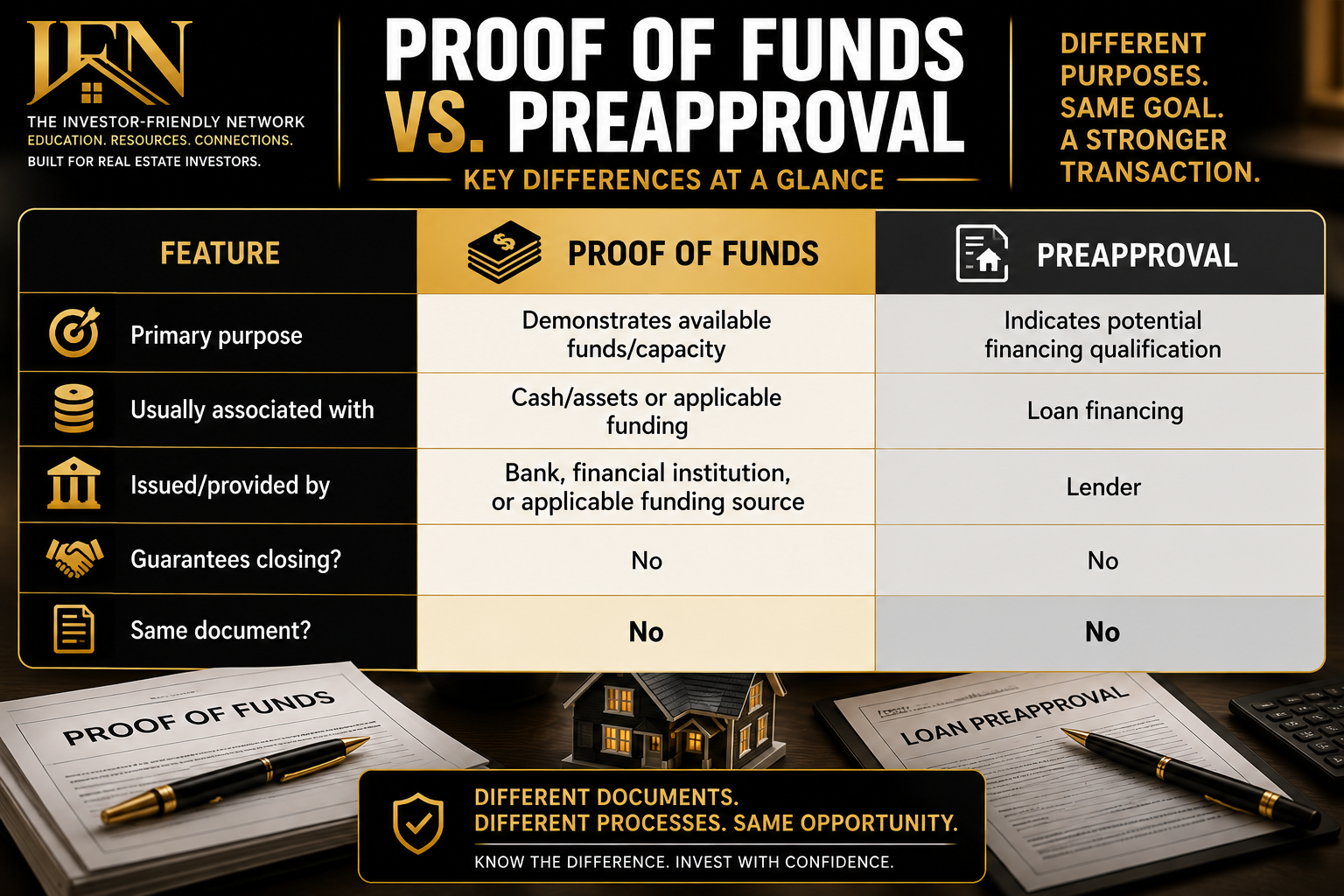
Proof of Funds vs. Preapproval
This distinction deserves its own section because the two are frequently confused.
Proof of Funds
Generally demonstrates available funds or financial capacity relevant to the transaction.
Loan Preapproval
Generally indicates that a lender has evaluated certain borrower information and conditionally determined that the borrower may qualify for financing, subject to the lender's terms and additional requirements.
A preapproval therefore doesn't necessarily mean:
“This buyer has the entire purchase price sitting in cash.”
Likewise, a bank statement showing cash doesn't mean:
“A lender has approved this buyer for a mortgage.”
They're different documents serving different purposes.
At a Glance
Proof of Funds
What Counts as Proof of Funds?
There isn't one universal answer.
Depending on the transaction and recipient's requirements, documentation could involve:
Checking or Savings Accounts
A statement or financial-institution letter may demonstrate accessible cash.
Money Market or Other Liquid Accounts
Certain readily accessible assets may potentially be accepted depending on the requirements.
Investment Accounts
Whether these qualify—and at what value—depends on the transaction and the person or institution evaluating the documentation.
For mortgage underwriting, for example, Fannie Mae recognizes several types of asset statements while imposing documentation requirements for verifying funds.
Funding Documentation
An investor using third-party financing may have documentation from the applicable funding source.
But this requires an important warning:
A funding letter should never be presented as though money belongs to the investor personally if that isn't true.
Be accurate about what the document represents.
Does Proof of Funds Mean the Money Has to Be Yours?
Not necessarily in every transaction—but the source and availability of the funds matter.
An investor may purchase using:
Personal funds
Business funds
Private financing
Hard-money financing
Transactional funding
Other legitimate funding sources
Each source may require different documentation.
For mortgage lending specifically, documentation of assets and the source of certain deposits can matter substantially. Fannie Mae, for example, requires lenders in applicable purchase transactions to document certain large deposits used toward down payment, closing costs, or reserves.
So investors shouldn't think of POF as:
“Find any letter that says I have money.”
Instead think:
“What funds are actually available for this transaction, and how should that availability be accurately documented?”
That's a much better mindset.
Proof of Funds and Transactional Funding
Suppose an investor is considering a double closing.
Remember:
A-B: Seller → Investor
B-C: Investor → End Buyer
The investor may need capital to complete the A-B purchase.
A transactional funding provider may offer funding for qualifying transactions and may provide documentation associated with that funding process.
But investors should understand exactly what any POF document represents.
Ask:
Is this merely a preliminary POF letter?
Has my actual transaction been reviewed?
What conditions still need to be satisfied?
Does the provider need the A-B and B-C contracts?
When does the funding commitment become final, if at all?
What could cause funding not to occur?
That's important because:
A proof-of-funds document is not automatically the same thing as final approval or an unconditional commitment to fund.
Continue Learning
Proof of Funds and Double Closings
Proof of funds can also intersect with the transaction structure itself.
An investor contemplating a double closing should understand:
What funds are needed for A-B?
Where will those funds come from?
What documentation does the seller require?
What documentation does the closing professional require?
What does the funding provider require?
What happens if B-C doesn't close?
This is another reason investors should understand the transaction before shopping for funding.
Continue Learning
Proof of Funds Does NOT Mean “Guaranteed to Close”
A POF letter can demonstrate something about available funds at a particular point in time.
It doesn't eliminate everything else that can affect a transaction.
A deal could still encounter:
Title problems
Contract issues
Funding conditions
Property-related issues
Closing delays
End-buyer problems
Documentation deficiencies
Legal or regulatory issues
Changes in available funds
That's why sellers and investors shouldn't treat POF as a guarantee.
Proof of funds is one piece of transaction due diligence—not a substitute for it.
Be Careful With “Instant Proof of Funds” Offers
New investors sometimes encounter websites or individuals offering quick POF letters.
That doesn't automatically make a service illegitimate.
But you need to understand what the document actually represents.
Before using one, ask:
Who is issuing the document?
Are the funds actually available under stated conditions?
Can the issuer verify the document?
Is there an application or approval process?
Does the letter accurately describe the funding relationship?
What conditions must be met before money will actually be provided?
Does the seller or closing professional accept that type of documentation?
And most importantly:
Never alter, fabricate, or misrepresent financial documentation.
A document should accurately represent the facts.
Questions Investors Should Ask About POF
Before submitting proof of funds, consider asking:
What type of POF will you accept?
How recent does the document need to be?
Does it need to show the entire purchase price?
Can sensitive account information be redacted?
Does the buyer/entity name need to match the contract exactly?
Will you accept funding-provider documentation?
Does the POF need to be independently verified?
Is financing documentation also required?
Are there additional requirements for LLC or entity buyers?
Will updated POF be required before closing?
Don't simply ask:
“Where can I get a POF?”
Ask:
“What does this particular transaction require?”
Common Proof of Funds Mistakes
Mistake #1: Assuming Every Seller Accepts the Same Document
They don't necessarily.
Verify the requirements.
Mistake #2: Confusing POF With Loan Approval
Available funds and financing approval are different concepts.
Mistake #3: Exposing Too Much Personal Information
Protect sensitive financial data while still satisfying legitimate verification requirements.
Mistake #4: Using an Outdated Document
Some recipients establish recency requirements.
For example, a current investment-property listing in Texas specifically requires POF dated within the previous 30 days—an example of why investors should check the actual seller's requirements rather than relying on a universal rule.
Mistake #5: Assuming a POF Letter Guarantees Funding
It doesn't necessarily.
Understand any conditions behind the document.
Mistake #6: Misrepresenting the Source of Funds
Documentation should accurately reflect the actual funding situation.
What About Proof of Funds for an LLC?
Many investors purchase properties through business entities.
If the buyer on the contract is an LLC, seller or closing requirements may involve documentation connected to that entity.
Depending on the transaction, someone may request:
POF reflecting the purchasing entity
Entity formation or organizational documents
Information showing who is authorized to act for the entity
Other documentation required by the seller, lender, title company, or attorney
Again, there isn't one universal rule.
In fact, current property listings sometimes expressly impose additional documentation requirements for LLC buyers.
The safest practice is simple:
Ask before submitting the offer.
Proof of Funds Is About Credibility—but Also Accuracy
A strong real estate investor doesn't just want to look capable of closing.
They want to understand whether they actually can close.
There's an important difference.
Before submitting an offer, investors should understand:
Purchase price
Earnest money
Funding source
Closing costs
Required reserves, if applicable
Funding conditions
Closing timeline
Exit strategy
What happens if the expected funding doesn't materialize
That's how POF fits into the bigger investing picture.
It isn't merely a piece of paper.
It's part of understanding whether the financial side of the transaction makes sense.
Frequently Asked Questions
Is proof of funds required for every real estate offer?
Not necessarily. Requirements depend on the seller, transaction, financing, market, and other circumstances.
Is a bank statement proof of funds?
It can be. Bank statements are commonly used to document assets, although the recipient determines what documentation is acceptable for a particular transaction.
Is a preapproval letter proof of funds?
Not in the same sense. A preapproval concerns potential financing qualification, whereas POF generally documents available funds or assets.
Can a funding company provide proof of funds?
Some funding companies provide documentation associated with their funding programs. Investors should understand exactly what the letter represents, what conditions apply, and whether the recipient will accept it.
Does POF guarantee that someone will close?
No. It does not eliminate other contractual, title, financing, property, legal, or closing issues.
Should I send my full bank account number?
Avoid unnecessarily disclosing sensitive financial information. Ask the recipient what information must remain visible and whether sensitive information can be appropriately redacted.
How recent should POF be?
There is no single universal age requirement. Ask the person or organization requesting it. Requirements can be transaction-specific.
The IFN Approach
Don't Just Prove You Have Funds. Understand the Funding.
Proof of funds can help establish credibility in a real estate transaction.
But sophisticated investing requires more than obtaining a letter.
Investors should understand:
Where the money is coming from.
What conditions apply.
What the money will cost.
When it becomes available.
What happens if the transaction changes.
And most importantly:
Whether the funding actually fits the deal.
Learn the process. Verify the details. Make more informed decisions.
Continue Learning
Understanding a Double Closing?
Exploring Short-Term Funding?
Need a Closing Professional?
Looking for More Investor Resources?
Educational Disclaimer: This article is provided for general educational and informational purposes only and does not constitute legal, financial, lending, tax, real estate brokerage, or investment advice. Proof-of-funds requirements, acceptable documentation, financing requirements, asset-verification procedures, seller requirements, and closing practices vary by transaction, funding source, institution, and jurisdiction. Investors should independently verify requirements and consult appropriately qualified financial, lending, legal, title, tax, or other professionals regarding their specific circumstances.
